Leave a comment

I’m (Sort Of) Flying!

For most of my life my family has vacationed down on the Outer Banks of North Carolina on Hatteras Island. Each year we’d pass the massive sand dunes of Jockey’s Ridge and see the people learning how to hang glide and each year I’d say “I want to learn to do that.”  When you’re a kid you don’t have much control over your pocketbook (or your destiny for that matter), so I never had the chance.

When I grew older, it was a time thing, we’d pass the flight school at Kitty Hawk Kites and I’d still say “I want to learn that,” but then get concerned about the time it would take. So, when we saw Kitty Hawk Kites Hang Gliding hosting a demo at the Travel and Adventure Show in DC in March I just had to take a turn.  Beforehand I spoke with the instructor about why people have a fascination with this kind of flight.

He also said one of the best things is that hang gliding is for all ages and athletic ability levels. The youngest person he taught was only three years old and the oldest was ninety-three, making my middle-age status no excuse. I slipped on the harness and let myself hang, in this case only a few feet from the ground.  He said for a sport that seems very adventurous it’s quite easy to pick up and the computer demo would easily prove it.

I won’t say I was great, but the fundamentals seemed pretty easy.  You subtly push your body to the side the triangle you want to go to and push up and back for up and down. I have to say that the trepidation I had felt for the real thing faded fast and was already planning on how to squeeze the real thing into our next trip to the beach.

The practical side in me was also worried about investing in the sport (gear and harness that Walter says you can find used and in great condition). Where was I going to go, would we have to spend all our time on the dunes of Jockey’s Ridge?

The beginners lesson on Jockey’s Ridge costs $99 for about three hours. The more advanced lessons that take place about an hour inland at the Currituck County Airport where you soar to 2,000 feet  start at $149.  But, I imagine like many things if you’ve been bit by the bug, you’ll find a way to make it happen.

So if you want to take a leap of faith however small give it at try, because how cool does it sound to say “yeah, I hang glide”?

2 Comments

Accurate Africa, from Disney’s The Lion King

I can’t honestly say “everything I learned about Africa I learned from Disney’s The Lion King“, but our trip to Tanzania last month revealed at least four key things the movie taught me about the area and its people. I had no idea any of these points were based in fact, but in retrospect I’m not surprised (the folks at Disney are pretty clever).

Image courtesy: lionking.org

For example, did you know elephant graveyards really exist? Silly 14-year-old me thought it was just a way to describe an area the young Simba and Nala should avoid: scary and dangerous.

Did they take dramatic license? Sure. But I was impressed elephant graveyards have basis in fact.

As our guide explained during our drive through the Ngorongoro Crater, old elephants seek out softer leaves as their teeth wear down, bringing many of them inside the crater where it’s more readily available. When they do reach the ends of their lives, the bones are left behind in that general area. There aren’t dozens and dozens of skulls (or barren expanses of rock shrouded in dramatic fog, for that matter), but the concept is accurate.

Another surprise (at least to me) was that the phrase “hakuna matata” actually exists in Swahili. In fact, in 1980 a Kenyan hotel band created a song that features the phrase (which literally translates to “there are no worries”) in its refrain. I kept thinking I heard it mixed into conversation between staff-members at our camp sites, but shrugged it off figuring I must be hearing similar sounds and blending them into something I’d heard in the movie. Then, this happened:

This small group of Iraqu performed for us before dinner our first night at the Ngorongoro Farm House (and recruited us to join the dance – you can see Zeke’s parents and Zeke himself in this clip). There’s no mistaking the refrain, so I suppose it “ain’t no passin’ craze” after all.

As we’ve heard before from travel expert Samantha Brown, learning a few key phrases in the local language can be a huge asset when you travel abroad. When I looked up how to say “thank you very much” in Swahili I was surprised to find a phrase I recognized from Rafiki’s song to Simba:

No, it’s not “squash banana”. “Asante sana”, the first two words in Rafiki’s rhyme, mean “thank you very much” in Swahili. We used the phrase a lot, and I smiled every time.

Lastly, I found it interesting that outcroppings of rock (some very similar to The Lion King’s Pride Rock) really do dot the savanna.

The rocks are remnants of volcanic explosions in the area; they were literally ejected and scattered across the Serengeti. Not only are the rocks out there – we even found lions hanging out on them.

So score a few for Disney; they taught me more than a realized about Africa.

Leave a comment

The Village Experience

We often talk about making an authentic connection with the places you travel here on No Kids, Will Travel, and a few weeks ago I met with Addison Demaree, travel manager for The Village Experience. Her company, based out of Chicago, is dedicated to its own down and dirty brand of cultural tourism.  The Village Experience is not just about staying in local hotels, it’s about making a difference while you’re there by focusing on voluntourism, cultural education and immersion.

Addison emphisized that the tours are customized for each group. For example, if you’re traveling with a group of teachers, they can find opportunities to help in schools; if you are a group of experienced Habitat for Humanity friends they can find a way to apply those skills. The trip is not just about what is needed, it’s about you and what you bring to the table.

While on a visit to locales like Haiti, Kenya and Thailand, travelers stay in neighborhood  hotels and eat at locally-run restaurants in the community you are helping, adding to the immersive “off the beaten path” experience.  Addison said you learn quickly that it’s about fitting in, from the way you dress to the tone of your voice in conversation; and isn’t that what immersion is about?

I know you’re thinking “this all sounds nice, helping orphans and all, but what about my safety?” Addison explained it’s about who you know. The guides they have accompanying the groups are locals themselves, and have that local knowledge that won’t have you going down the wrong alley and stumbling into trouble. The Village Experience  tour groups also visit the same locations on a regular basis, building relationships and creating a bubble of safety.

You don’t have to worry about the whole trip being spent laying bricks or putting in clinic hours, you have the option of taking the day off and staying at the hotel or having an adventure in the countryside.  The amount of time you spend laboring or visiting is up to you.  So if you are traveling with a group with lots of energy for doing good works, The Village Experience will find the work, if you are traveling a group that is more interested in a cultural experience they can immerse you in culture, if you want to spend more time vacationing than volunteering that can be arranged, too. The trip is your trip; you get out of it what you want.

But, it’s a trip that’s about more than time spent on the beach, or shopping, or that wonderful meal. A trip with The Village Experience is about changing your social consciousness.

8 Comments

Seeing Africa’s Big Five

Africa’s big five include elephant, rhinoceros, lion, leopard and buffalo. We were fortunate enough to see all of them (and many of them more than once) during our safari in Tanzania last month.

The first big five animal to be checked off our “must-see” list was the elephant.

The elephants in Tarangire National Park kept their distance more than those we encountered later on the Serengeti, but our rented 500 mm lens helped us get fantastic photos to go along with our memories of these majestic giants.

We chased reports of lions off and on during our first game drive. Our guide, George, seemed disappointed we didn’t see any that first day, but Zeke’s mother said it best, “if we wanted to be guaranteed to see lions, we would have stayed home and gone to the zoo.”

Our patience only had to last until our second game drive. Near the end of the day we found a group of six females lounging in the shade of a baobab tree. We would see lions every day through the rest of our adventure. I could have spent untold hours just watching them settle into comfortable positions for naps (they sleep about 20 hours each day).

We checked African buffalo off of our big five list as we entered the Ngorongoro Crater. Herds of them were gathered on the inside slope of the 100-square-mile crater, almost like a lumbering welcome committee.

Later that same afternoon, we spotted rhinoceros trotting across the floor of the crater. The rhino was the only animal we wish we could have been able to see at least a little closer. They were very mobile, but just happened to stay out in the middle of the grassy plains rather than approaching any available dirt road. Again, the 500 mm lens came in very handy!

By the time we arrived in our Serengeti camp (our final stop on our safari), we had checked off the last member of the big five: leopard. We spotted a leopard mother and her cub up in a tree on our way from the Ngorongoro Conservation Area to the Serengeti. The following afternoon we found another leopard in a tree – this one just about one kilometer from our campsite!

Our safari was an amazing experience, and it wouldn’t have been any less so if we had missed the chance to see one or more of the big five. These may be the animals people flock to Africa to see, but the area has so much more to offer. For example, who knew I’d find hyena so adorable?

But let’s save that for another post…

1 Comment

A Better Way to Carry Your Gadgets and Gizmos

I know as a modern traveler we have to put up with a lot of things: airport lines, baggage fees and transporting all of our toys and gizmos safely and securely are just the beginning of a very lengthy list. At the DC Travel and Adventure Show last month I caught up with a man who thinks he has a solution to at least that third problem. He’s Scott Jordan, CEO of Technology Enabled Clothing and Scottevest.

Scottevest was formed 13 years ago to solve the problem of tech gear and travel. As you may remember from my previous post about packing for Africa, my camera equipment took up all the space in my carry-on bag and left me little room for anything else. After talking to Scott Jordan I might finally have an option other than agonizing over which tech gets left behind.

Image courtesy: Scottevest

Jordan has designed travel vests, jackets and other clothing that let you carry a Kindle, iPhone, iPad, sunglasses, camera, passport, keys, water, pens, headphones, wallet, and even a bottle of water (not through TSA security, of course). When I met Scott I had to ask: why? And, as in most cases, it seems necessity was the mother of invention.

I’ve owned a couple of travel vests over the years, one of which is a genuine army-surplus cargo jacket and the other one was make by Bugle Boy, yes Bugle Boy.  They both have served me well on vacation and at work.  I loved the ability to carry lots of things, but all of the pockets were up front and on the outside of the jacket. Having all of the weight distributed in the front made the vests (and me) look sagged and sloppy.  It’s a look that can work for some, but not if you have some weight up front already. So, again, Scott Jordan looked at a problem and solved it, by taking weight distribution and style into account.

I’m not pitching these jackets for money. I’m not even getting a discount.  I don’t even own one, but I am considering it, because while I do always want to be able to carry my tech gear, I don’t think it’s always appropriate to look like an over-prepared fly fisherman or shutterbug tourist.

3 Comments

Africa: Through a Borrowed Lens

I am a photographer, and as a photographer I like cameras. I have a collection of more than 20 antique ones and love adding to my toys.

When we decided to go to Tanzania on Safari I thought “giddy up! I can justify getting that new lens I want!”  Well, as much as I wanted to, I couldn’t justify spending another $1,000 on a lens with more power than I’ll need for just about any other shoot I could imagine.

Then, I thought a used lens would save money. I called around and couldn’t find a good deal. As I made my inquiries, a camera shop I trust suggested borrowlenses.com. It was just what I needed.

I was able to find a Tamron 200-500mm lens for my Nikon DSLR and rent it for two weeks for $150 (including taxes, shipping and insurance). It didn’t have auto focus, but that didn’t really bother me. I’m pretty sure I can focus faster on the fly – and on the subjects I want – anyway. I’m pretty happy with the results, what do you think?

This Black Rhinoceros went for a trot across the Ngorongoro Crater, but was WAY too far away for any of the lenses we own. The rented lens brought him close enough for a great action shot!

This Black Rhinoceros went for a trot across the Ngorongoro Crater, but was WAY too far away for any of the lenses we own. The rented lens brought him close enough for a great action shot!

We were surprised to spot this Honey Badger (they're typically nocturnal) running along the edge of a pond in Tarangire National Park. Once again, the lens made all the difference.

We were surprised to spot this Honey Badger (they’re typically nocturnal) running along the edge of a pond in Tarangire National Park. Once again, the lens made all the difference.

This lazy lion in a tree would have been hard to capture with our standard telephoto.

This lazy lion in a tree would have been hard to capture with our standard telephoto.

2 Comments

Africa in the Movies

We’re about to take our big trip to Africa and thought you could come along, at least in a vicarious sense. I put together a small list of some of my favorite films about Africa that might let you escape there for at least an hour.

The contemporary films out there aren’t exactly relaxing; films like Blood Diamond, Last King of Scotland, and Hotel Rwanda are great films, but not kind of escapism we’re going for.  I want the vicarious traveler to relax and enjoy, not feel like they have to escape a dangerous situation.

The first film I’ll recommend is one of my favorites: 1985’s Out of Africa starring Robert Redford and Meryl Streep. For being almost 30 years old, the film doesn’t show its age at all.  You will get caught up in the scenery and the love story.

The second film is a classic in every the sense of the word: The African Queen, staring Humphrey Bogart and Katharine Hepburn.  The 1951 film takes place during World War I as a riverboat captain with a drinking problem ferries a missionary down the river to Lake Victoria.  The African Queen is a romance with action and adventure, and shot entirely in black and white.  I whole-heartedly recommend this movie for its nostalgic, if somewhat dated, view of the Dark Continent, and the classic adventure tale.

Disney Nature’s African Cats a wonderful documentary narrated by Samuel L. Jackson that follows two families of big cats as they teach their cubs how to survive in the wild.  I remember as a kid Disney produced dozens of nature documentaries and being riveted by them, this one with its spectacular visuals doesn’t disappoint.

The fourth film is truly a dream, I Dreamed of Africa, the 2000 film staring Kim Basinger.  The story of a widow and her family moving to Kenya with a new husband and starting a cattle ranch is real story of determination.  I know many of us dream of living in the midst of beautiful African vistas, but this film reminds us that it’s also filled with murderous poachers, lions, snakes and tribal customs that need to be learned to survive.

While not technically a movie, the Africa episode of Discovery Channel’s Planet Earth was amazing.  The video is captivating. You see the animals of the savanna great and small living, surviving and thriving.  I am still amazed as they did an aerial chase of a pack of wild dogs on a hunt.  You get to see them use complex strategies to encircle their prey.  The episode on a wide screen is as close to an actual safari as you can get without leaving your living room.

We’ll be back from our own safari soon and we promise plenty of posts and pictures for you to peruse.

1 Comment

Before You Go…

I think we can all agree there’s a lot of work that goes into getting away. Planning the trip, paying all of the up-front costs (plane ticket, etc.), tying up loose ends at work, arranging for a house-sitter and pet-sitter, putting a hold on your mail and newspaper… the list goes on and on.

Beyond all of the stuff you have to do, we have a few traditions for before we go (whether it’s a trip to the beach or to another continent).

First, I like to clean. Okay, maybe I don’t exactly like doing it, but it’s part of the routine. I like knowing we’ll come home to our tidy abode. A freshly-cleaned bathroom is a beautiful thing after any amount of time on the road, on a plane, you name it. Yes, dusting and vacuuming before you leave for a couple of weeks may be somewhat futile, but I like to do it anyway.

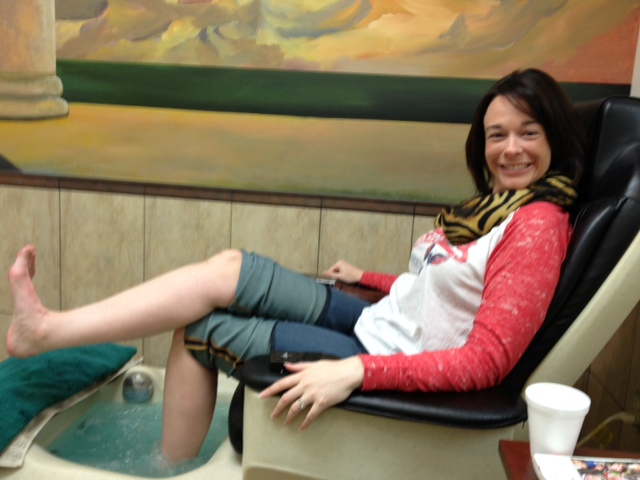
Many thanks to the lovely April Finnen for taking this pedi photo!

Many thanks to the lovely April Finnen for taking this pedi photo!

Next up: pedicure. Zeke laughs and shakes his head every time, but indulging in a pedicure helps me downshift into vacation mode. My ever-practical husband asks “who’s going to see your feet?!” — to which I respond “I will!” Seriously, though, is there a better feeling than digging your perfectly-painted toes into soft sand? Yes, I still get a pedicure even when we’re not going to a beach. It simply feels good and right.

Pedicure: complete. Now we're ready to go!

Pedicure: complete. Now we’re ready to go!

When we travel with Zeke’s younger sister, Andrea, Zeke always hits the comic book store and buys her a little stack of reading material — generally Danger Girl comics. The tradition dates back to 2002 when Zeke, Andrea and their brother, Zach, toured Egypt. It was Andrea’s first (of many) trans-Atlantic flights.

One more tradition (and this one can be filed under deep, dark secrets): if we leave in the morning, we go to McDonald’s for breakfast. For some perspective, you should know we can count the number of times each year we visit a fast food drive thru on one hand. It’s not a high-brow thing, it’s a waistline-control thing. So this trip to McDonald’s is  a clear demarcation between “normal” and “vacation” time.

Do you have any pre-travel traditions? Do tell!

6 Comments

Packing Light?

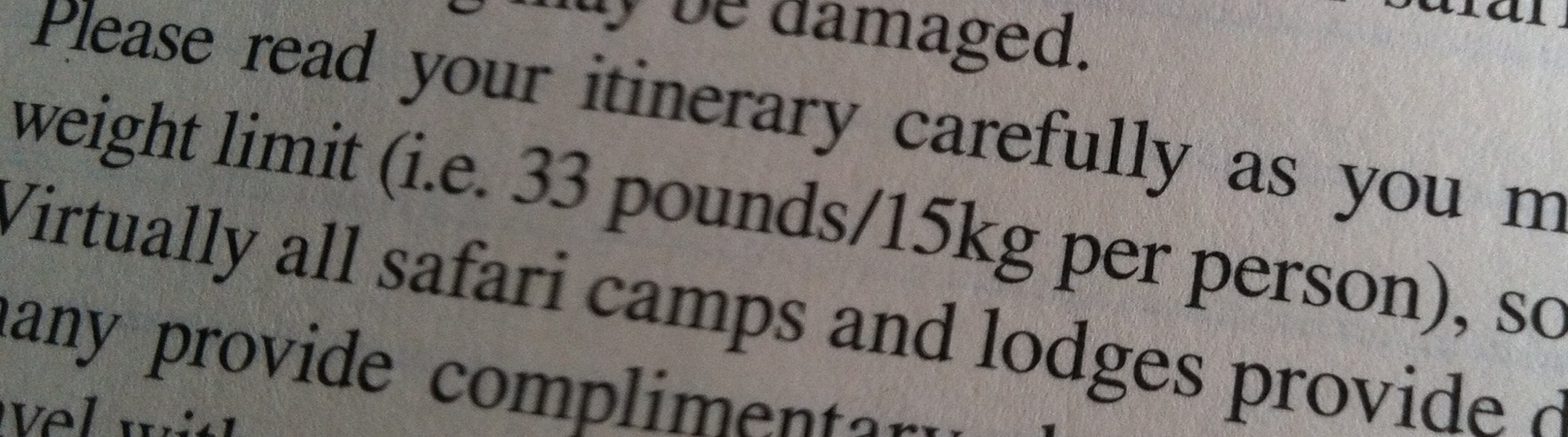
The travel guide specifically says 33 pound or 15 kilograms total baggage weight.

The travel guide specifically limits each traveler to 33 pounds (15 kilograms) total baggage weight.

I know 33 pounds sounds like a lot, especially to someone who carries a 25-pound camera for a living. But when you’re cramming everything you need (and think you need) for a two-week trip in a country you’ve never visited the weight limit seems like a real challenge.

I understand the reason for the weight limit, I really do. Near the end of our African adventure, our plans call for us to board a small plane for a flight back to Arusha. The small plane, if overloaded, could come crashing down in the middle of the savanna, giving the hyenas a tasty snack of seared me. So I’m taking the 33 pound rule seriously.

The Africa Adventure Company sent us packing lists with our guide books and said following their guidance should keep you within the weight limit. I packed the recommended six sets of underwear, five pairs of socks, a wide-brimmed hat and swim trunks and took the rest of the list under advisement.  If you’re wondering how you take a two-week trip with six sets of underwear the answer is laundry services.

The list said you should pack three pair of shorts, three pants, three short sleeve shirts, and three long sleeve shirts, but I decided to rebel and throw caution to the wind by packing only three pair of pants. I’ll be wearing one (you’re welcome, fellow travelers), leaving me four pair in total, and five long-sleeve shirts.

Honestly, if you compared what I packed to what was recommended, I’m pretty sure I’d come in under the limit. The real weight comes in the non-clothes category; remember the 33 pounds was total for my luggage. No matter how many bags the total would have to be 33 pounds or less. It’s like one of the word problems you got in school:

If Zeke packed two bags and bag A was 15lbs, and he had a second bag B, and the total weight was 33lbs, how much weight was bag B?

Well, I’ll let you take some time to figure that out and continue. I’m a photographer and I’m about to travel to one of the most spectacular scenic places on the planet, the Serengeti. How do I resist taking every piece of camera equipment I own? Well, I almost don’t.

I have two digital SLRs, four lenses (one I don’t even own, it’s a rental 500mm), the charging equipment, the lens hoods, a spare battery, Flip camera, microphone, inverter charger, flash and binoculars.  I’m leaving the tripod at home; I find them too cumbersome for a trip on the move.  I also packed my Kindle, moleskine journal and sketch book. I have more gear but just had to leave it in the closet.  I’m pretty good at making do.

So class, have you figured out the answer to our word problem?

If you figured out the answer is 18lbs that’s a gold star for you.  I can’t wait to share all of our experiences in Africa with you. See you soon.

Ten days worth of clothes still doesn't weigh as much as my camera gear.

Ten days worth of clothes still doesn’t weigh as much as my camera gear.

2 Comments

Avoiding Pesky Travel Fees

If there’s one thing my father taught me from a very early age, it’s that you should never pay someone for the so-called privilege of spending your own money. It can be pretty hard to stick to that advice when traveling — especially these days.

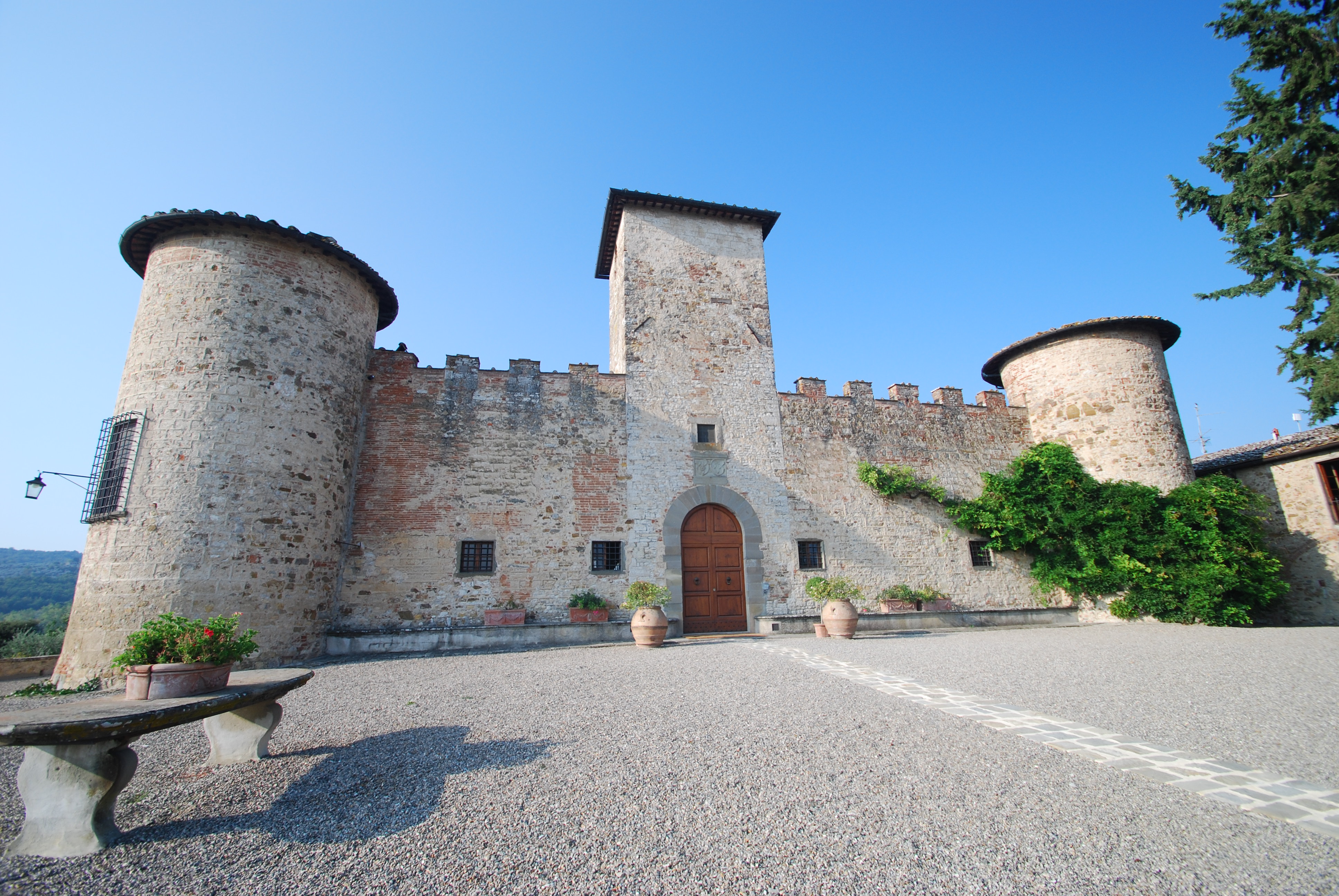
Castle Gabbiano was our home for two lovely nights on our 2011 trip to Italy.

Castle Gabbiano was our home for two lovely nights on our 2011 trip to Italy.

Case in point: our last trip to Italy. We used a credit card to pay for our hotel (and castle, pictured) rooms, understanding that the card carried an international transaction fee. What we didn’t know (and it was a silly mistake, we realize) was exactly how much we’d end up paying in fees. It wasn’t insignificant, and I was displeased to shell out “free money” to the credit card company (name withheld because we’re just nice like that).

With our next international trip (to Africa) approaching, we decided it was time to seek out another, fee-free option.

I did our homework and found that many, many credit card companies offer cards that do not charge international transaction fees. Great, right? Not so fast.

The vast majority of those cards require an annual fee for the privilege of using them at all — not just internationally. I knew credit card companies were greedy, but we both have credit ratings well into the “excellent” range. I was surprised to see so many companies charging annual fees on these cards (yeah, I may be a little naive).

Finally, I was able to find a card that won’t charge fees for international use (in fact, none of their cards charge an international transaction fee) and doesn’t charge an annual fee (for customers with excellent credit). The Capital One Cash Rewards card will make the trip to Africa with us, so – finally – we won’t be paying fees for spending our own money.

My dad will be so proud!

How do you avoid pesky fees when you travel? Know any good tricks to avoid paying to check a bag (aside from choosing an airline that doesn’t charge)? A great way to get an upgrade for a discount or free? Share it! Sharing is caring!

*No disclaimer needed. Capital One isn’t kicking us a dime, we’re just reporting our honest-to-goodness experience and the results of our search.