Leave a comment

Japanese American Museum of San Jose

Japanese American Museum of San Jose

I made some time during my work trip to San Jose, California to leave the convention center and do a little exploring. The trip from downtown to Japan Town only cost about $15 dollars in a Lyft and took only about 10 minutes. I’ve been told that San Jose is only one of a handful of Japan Towns left on the west coast and it was worth the visit.

My first stop was the Japanese American Museum of San Jose. The unassuming building with its distinct eastern-inspired room and circular windows houses exhibits explaining the early immigration of Japanese to the west coast, the lives of the people, the creation of Japan Towns, and the internment of the Japanese Americans during the second world war. I was greeted by a Doosan after paying for my admission (under $10); he asked if I wanted a guided tour. I said sure. My guide then took me on a journey through the history of the Japanese in the Americas.

I learned a few things about Japanese immigrants such as Brazil actually has the largest Japanese-speaking population outside of Japan and that Mexico had a large immigrant Japanese population along the Sea of Cortez.

The men, of course, came over first and worked as laborers and farmhands. The Chinese Exclusion Act of 1882 stopped immigration from China, so American labor recruiters began targeting Japanese workers. This triggered a rapid increase in the country’s Japanese population, which in turn spurred the movement to decrease their number and restrict their economic and political power.


 

The men would then find a bride through a matchmaker back in Japan. They increased their chances of finding a match through a bit of false advertising; they’d rent some clothes and have a picture taken in front of a nice car or house and send it home saying they were very successful in the new world. The women, referred to as picture brides, would then journey with a large group of other brides to the new world. The ruse sometimes ended with the women dumping them at the docks and striking out on their own or heading back to Japan as jilted brides.

The pairings that went well ended with the couple getting married in a mass ceremony at the immigration halls before they entered the country.

The arrival of picture brides(1909)
Angel Island, California
Courtesy of California State Parks

The influx quickly resulted in push-back from nativist groups in California beginning a period of systematic discrimination against the Japanese. The laws like the California Aline Land Law of 1913 that was specifically created to prevent land ownership among Japanese citizens from residing in the state has been compared to the Jim Crow laws of the southern states to restrict the rights of blacks.

However, in State of California v. Jukichi Harada (1918), Judge Hugh H. Craig sided with the defendant and ruled that American children – who happened to be born to Japanese parents – had the right to own land.

The Japanese and those of Japanese ancestry born in the United States succeed in creating thriving communities and accumulating wealth. They had their own hospitals, hotels, neighborhoods, and even a baseball league along the west coast. It was a thriving community until the second world war, a history we will get into in our next post as we talk about the shameful internment of U.S. Citizens during the 1940s.


Leave a comment

A Trip Though Japanese American History (Coming Soon)

Buddhist “Church” in San Jose, CA

I took a trip out to San Jose, CA and stopped by their JapanTown. I’ll be able to give you a full report next week.

Zeke

Leave a comment

A Martian Experience is Closer than You Think

Mars from the Viking space probe
Courtesy: NASA/JPL/USGS

If you are a regular reader of this blog you know we love space. We are what you’d call “Astro-nuts.” We are always looking for ways to enrich our space-loving lives such as attending Space Camp. We’ve stumbled upon an experience that sounds awesome, that is if you have a month to spend pursuing a Martian fantasy.

Astroland Interplanetary Agency based in Spain is offering an immersive and demanding experience. The company has created a replica of a Mars colony deep in the caves of Cantabria, Spain. Ares Station is cut off from the rest of the world and gives you that on-another-world vibe. The cave has a ceiling 60 meters (197 ft) high and is 1.2 kilometers (3/4th mile) long. You will have the chance to test all of the technologies that would keep you alive on Mars. You will wear spacesuits and work in a habitat doing station maintenance, growing food, and other scientific tasks.

The website states, “We are proposing a demanding test full of rewards of incalculable value. Live on Mars and overcome everyday tests that our experts have designed for you from the absolute scientific rigor. You will see how by yourself, or with the help of others, we evolve and transform ourselves by offering our best version in unexpected and unexpected situations.”

Ares Station is equipped with everything necessary to test all the technologies and human performance capabilities that will be required to survive life on Mars. You will be a pioneer in the arrival of the human species to other planets.

You will live your day-to-day as an astronaut receiving orders from mission control for tasks to complete as part of this realistic experience. The mission even starts before you arrive as you will be remotely trained by a mentor prior to your assignment. When you arrive at Astroland you’ll go through some physical and mental training before entering the isolation of Ares Station.

We both think this is like a Space Camp experience turned up to 11. The idea of committing that much time to such an intense and immersive experience is a little intimidating. The price, however, isn’t that bad. At only $6,831 it comes in under the price of some luxury safaris. But it’s not a pay-and-play opportunity; candidates have to apply for their positions on the expedition and pass physical and psychological tests before they are accepted.

Phases of the mission include:

—Three weeks of remote training, during which the chosen team has direct online access to aerospace experts and reputable psychologists, such as Gabriel Gonzalez de la Torre, doctor of Neuropsychology at the University of Cadiz and one of the few leading astronaut psychologists from Spain, and also Inigo Munoz Elorza, instructor of astronauts in the European Astronaut Center, part of the European Space Agency.

—Three days of training at the Astroland Space Center, located in the Science and Technology Park of Cantabria, where mission participants learn how to carry out spacewalks by participating in speleology (caving) training, natural buoyancy tests that simulate the state of weightlessness, and will also receive training in emergency plans which will allow them to act in the case of adverse circumstances.

—The fully-prepared crew then enters the cave in Arredondo, Spain, where they test what human life would be like on Mars.

We’re putting this trip on our shortlist of dream vacations. It’s a little more realistic than our chances of being selected for a real crewed mission to Mars.

Starting dates for upcoming missions (with a maximum of 10 participants per expedition) include September 22, October 13, October 27, November 10 and November 24.

Leave a comment

American Airlines Makes it Easier to Get to America’s Caribbean

Courtesy: AA Newsroom

Getting to the U.S. Virgin Islands has just become a bit more convenient. Dallas-based air carrier American Airlines has announced that it will add a third daily flight between Miami and St. Thomas. American Airlines says the additional flight will operate as a “same-day turn” leaving Miami Airport (MIA) at 8:35 a.m. and landing at 12:04 p.m. at Cyril E. King Airport (STT). The plane will then be refueled, cleaned and turned around, departing for Miami at 1:04 p.m. and landing at 3:10 p.m.

And St. Thomas isn’t the only island getting more flights. American Airlines will also extend the Charlotte (CLT)-St. Croix (STX) flight from Saturday-only to daily during the peak Christmas period from December into January 2020.

The service will depart Charlotte Douglas International Airport in North Carolina at 11:45 a.m., arriving at Henry E. Rohlsen Airport at 4:24 p.m. The return flight will depart St. Croix at 5:15 p.m., arriving into Charlotte at 8:10 p.m.

American will resume flights from St. Thomas to Dallas-Fort Worth (DFW) and Chicago (ORD) beginning December 21, 2019. The Dallas flights will operate year-round on Saturdays, while the Chicago service will be seasonal.

Leave a comment

The Gulf (Stream) War: A Sail to the Bahamas


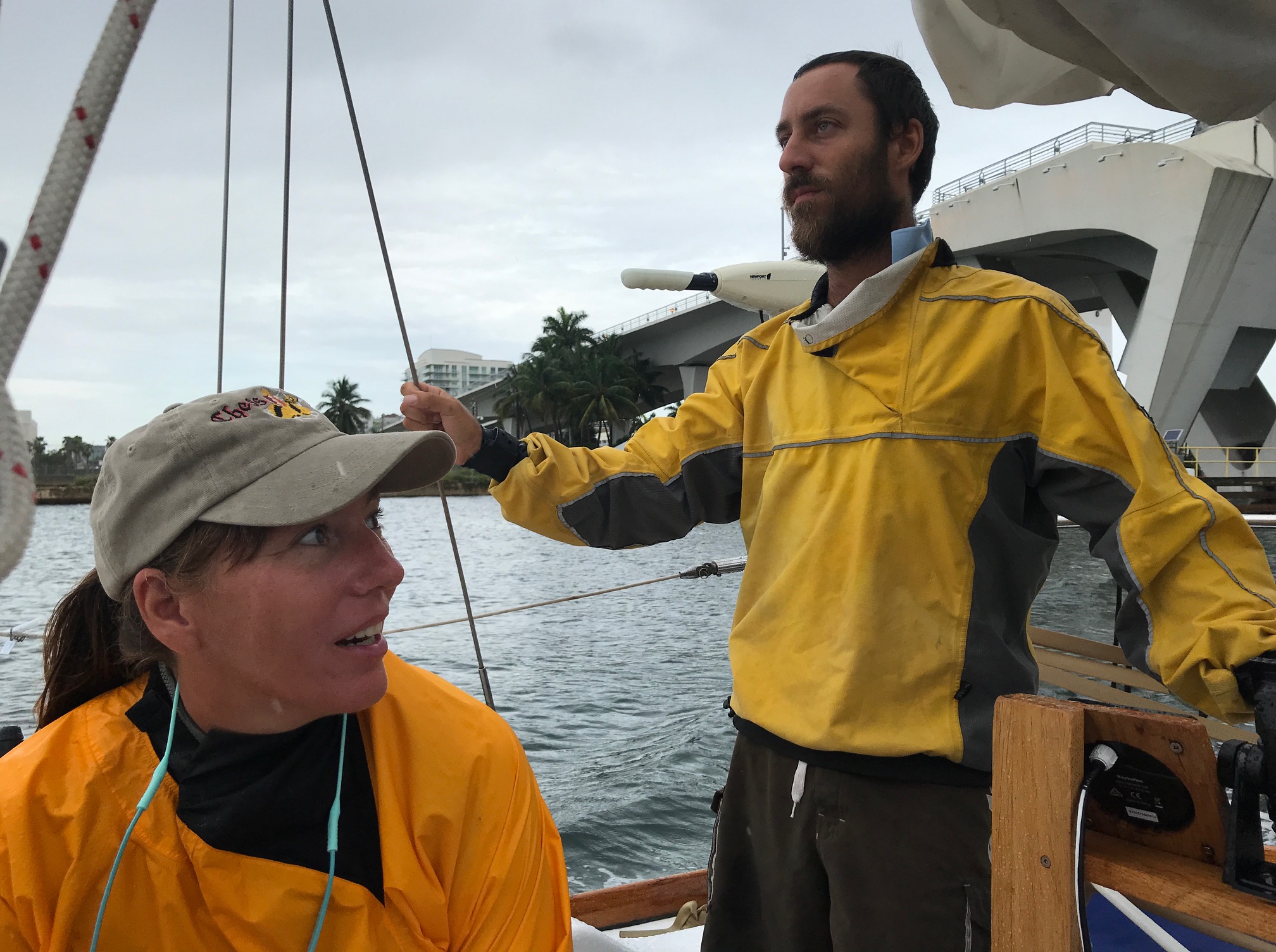
Andi and Matt dressed for foul weather

We’ve been teasing my sailing adventure with my sister and brother-in-law for some time now and it’s time to share some details. I arrived in Fort Lauderdale after driving across the Everglades in a rental car about a week and a half ago to meet Andi, Matt, and their crewmate Sam. I was geared up and ready to hit the high seas for a jaunt to the Bahamas in the 40′ sailing vessel Errant. I’d been preparing for this trip for the last 6-9 months and the time had finally come.

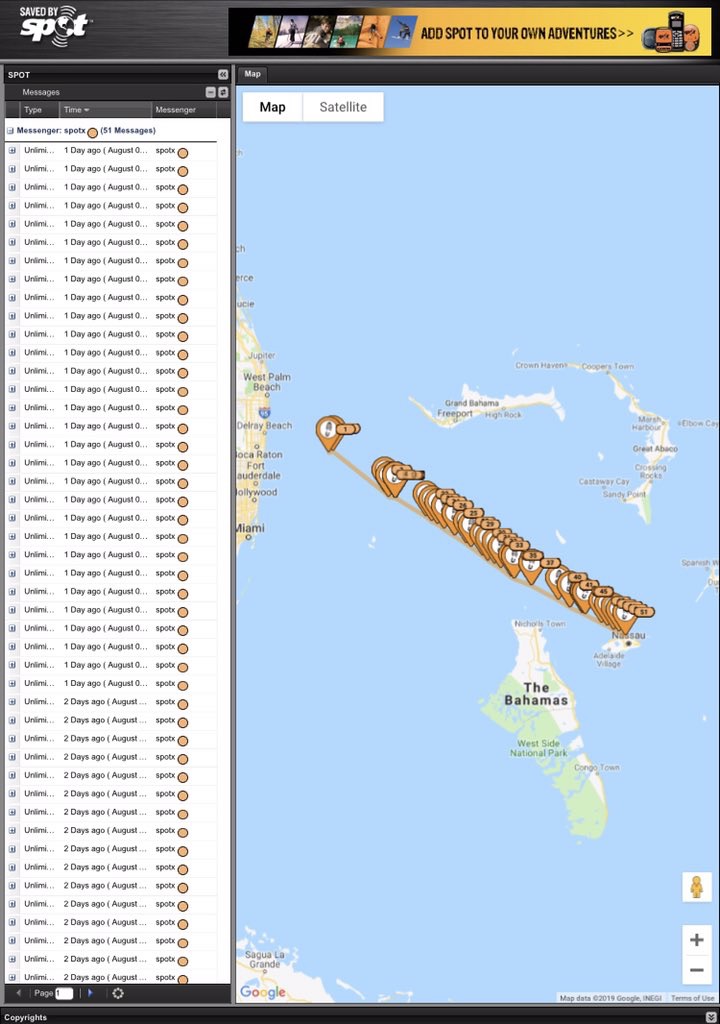
The original plan was for me to sail with them all the way to St. Thomas, but poor timing left me with only a few days aboard. I would be with them for one of the most difficult parts of the journey, crossing the Gulf Stream. The Gulf Stream is a current of warm water that stretches from the tropics and runs along the east coast of the United States from Florida to Newfoundland. The current averages about 50 miles wide and travels northward at around 5 miles per hour. A crossing from Florida to the Bahamas can be difficult if the weather conditions aren’t right, considering you are in the open ocean (aka blue water) during the journey.

The current from the Gulf Stream only adds to that difficulty. For example, if you are sailing in a straight line from Miami to Bimini, Bahamas it’s only 50 or so miles. You travel at 5 miles per hour in a sailboat so you’d figure it’d take you 10 hours to reach Bimini. The current of the Gulf Stream is moving northward at 5 miles an hour, so over the course of 10 hours, you will have drifted north as much as 50 miles, putting you way off target. If you have fair skies and helpful winds from the south you’ll be able to make landfall in Bimini without a problem by making simple course corrections to account for drift.

We were not so lucky.

The moment we left port the sky began to cloud over and the rain started to pound us even before the Florida shoreline disappeared behind us. The seas also began to kick up and we encountered 4-5 foot swells; on a 40′ boat in the middle of the ocean they felt massive as they sent the bow of the boat pitching up and then crashing down into the water covering everything with sea spray. I had to keep my sunglasses on despite the dark sky just to keep salt out of my eyes. The current and the wind pushed us way off course as we found ourselves closer to Freeport, Bahamas than Bimini, a near 60-mile difference north. We then turned into the wind and began to simply power our way through the pitching seas. The sailing term for that — whether under sail or under power — is called “beating into the wind” because you are punished every step of the way.  

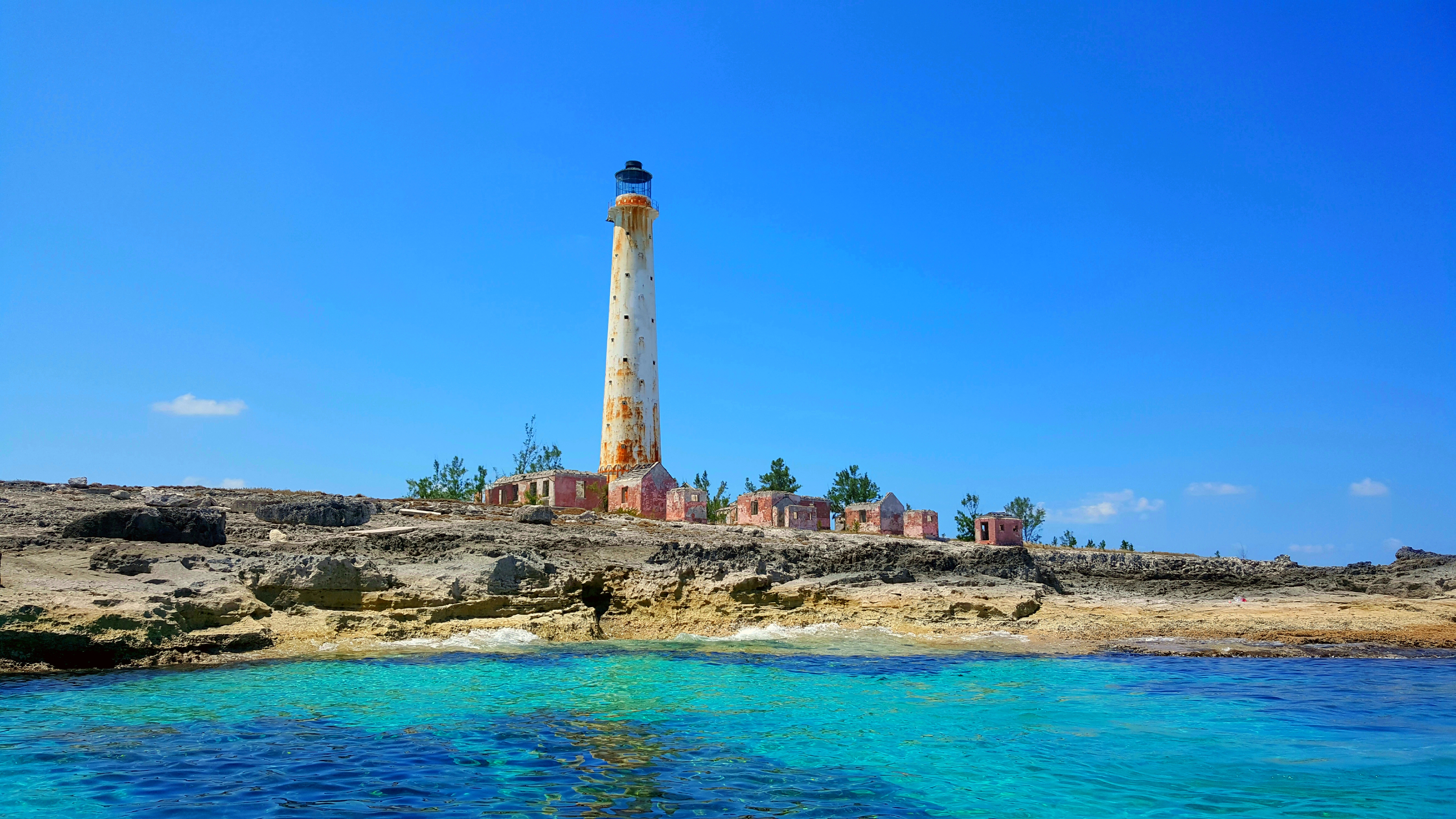
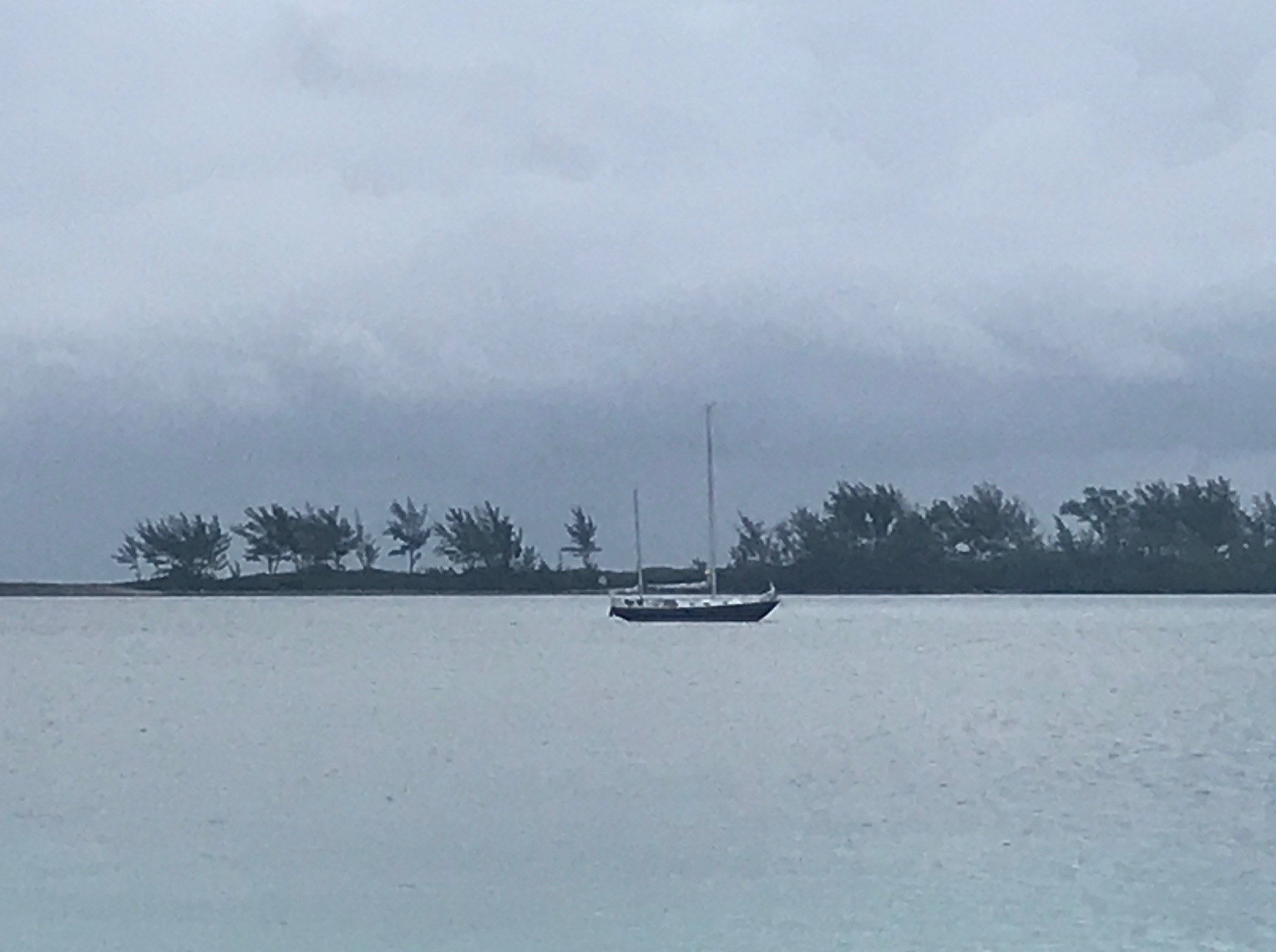
The foul weather was taking a toll and that convinced Matt that we, the crew, needed a real break, not just the breaks we were getting by sleeping in shifts. We found a semi-sheltered anchorage near Great Issac Cay; we dubbed it Shutter Island for its lighthouse and creepy vibe. Little did we know we weren’t too far off the mark.

Great Issac Cay
Courtesy – Michael S. King

The most prominent feature of the island is its lighthouse which was erected in 1859 and stands about 151 feet (46 m) tall. It has been claimed that a full moon causes unusual sounds to be heard on the small island. In the late 19th century local lore tells of a shipwreck on the island with one survivor, an infant. The child’s distraught mother, known as the Grey Lady, is said to haunt the island to this very day, wailing in sorrow during the full moon.

On August 4, 1969, the station was discovered to have been abandoned by its two keepers, who were never found…

—  Great Issac Lighthouse Wikipedia

The next morning we continued our trek southward toward Nassau, alternating between sailing into the wind or with no wind at all the whole way. We had 125 miles to cover and decided to run non-stop, each of us taking a watch of two hours at a time, two hours on, four hours off.

The seas became much calmer as we closed in on the Berry Islands and Chub Cay, a popular spot for cruisers. The depth of the water grew more shallow, around 25 feet, and took on the beautiful turquoise color we associate with the Caribbean as we glided through the flat sea.

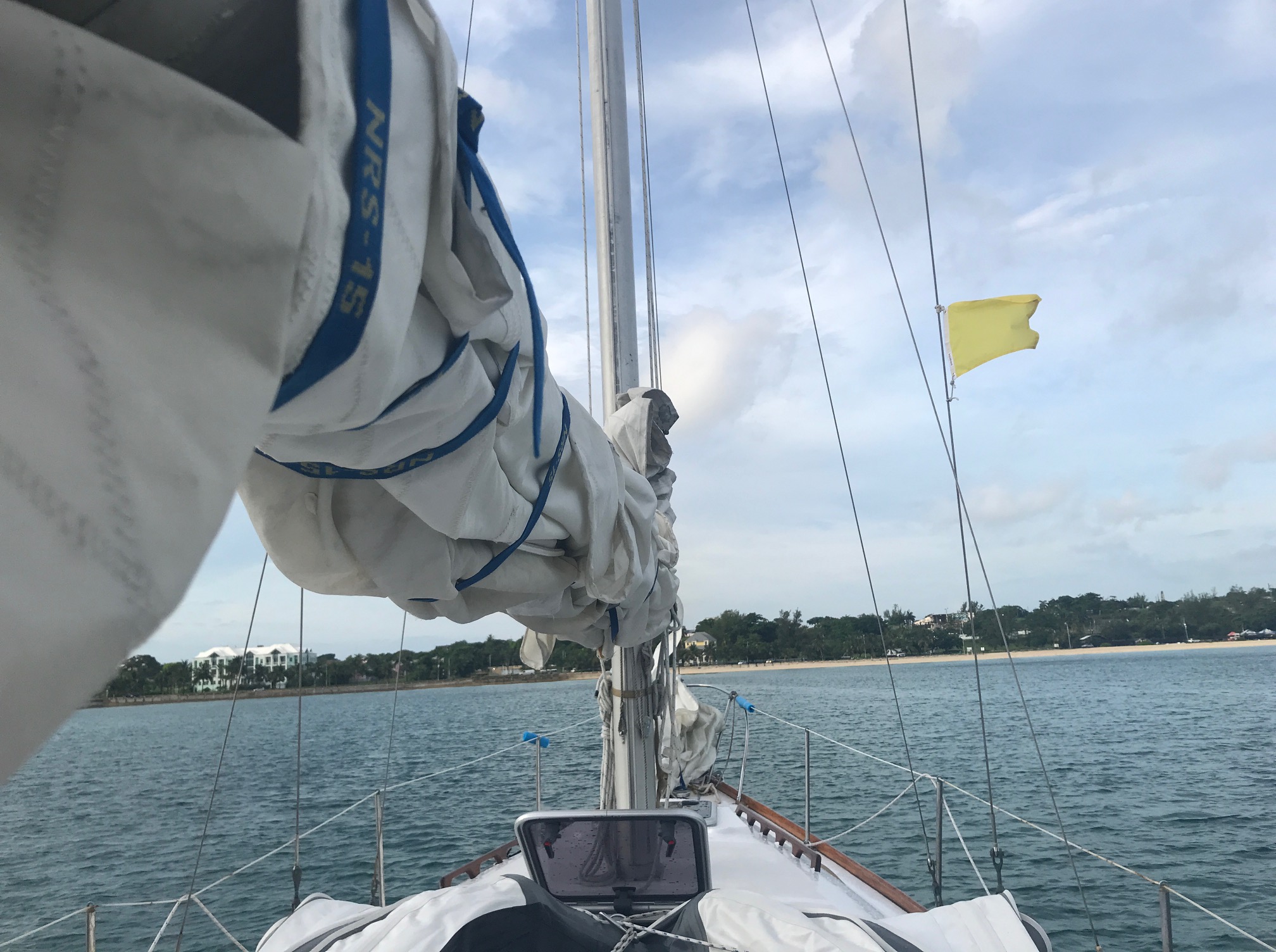
The light began to fade just as we came out of the shallows and into the stretch of 40 miles blue water separating the Berrys from Nassau. The night was filled with light, the steady glow of Nassau over the horizon and the frightening power of mother nature all around us. The atmosphere was electric as massive thunderstorms to port and starboard lit up the sky with near-constant bolts of lightning. I was ready to turn and head back to the Chub Cay and ride out the storm there but Matt had us push onward, saying that the storms were to the right and left but not in front of us and we could still see the lights of Nassau. I headed to my berth after my watch and woke up to the feeling of stillness. The boat wasn’t moving, the engine wasn’t running, the world around me was quiet and still. We were at anchor flying the yellow customs flag in Nassau Harbor, and my blue water service was at an end.

Flying the yellow quarantine flag in Nassau Harbor

Leave a comment

Preview: An Adventure-Filled Week

I’ll have a lot to tell you in about, but that will have to wait until next week.

The Wandering of an Errant

Nassau Harbor

Leave a comment

St. Pete Beach

We continued our tour of the beaches around Tampa this weekend with a stop at St. Petersburg Beach. The town and its municipal beach are set on a barrier island just off the coast of Pinellas County, Florida. The island has long, wide beaches and, at least during our visit, calm water.

The cute downtown area is lined with shops, restaurants, resorts, and some classic motels that remind you of yesteryear. We found some convenient parking in a municipal lot, it’s not Parkmobile compatible so bring change or your credit card. You will find a small beach store and place to wash your feet before the long 100-yard walk to the water.

The beach itself is hard-packed sand and the water is cloudier than Clearwater. You will also find beach chairs and umbrellas for rent but the vender only uses cash at that location. We enjoyed our restorative day at the beach and can’t wait to explore some more of the other beaches.

Leave a comment

Southern Caribbean Challenge 2019

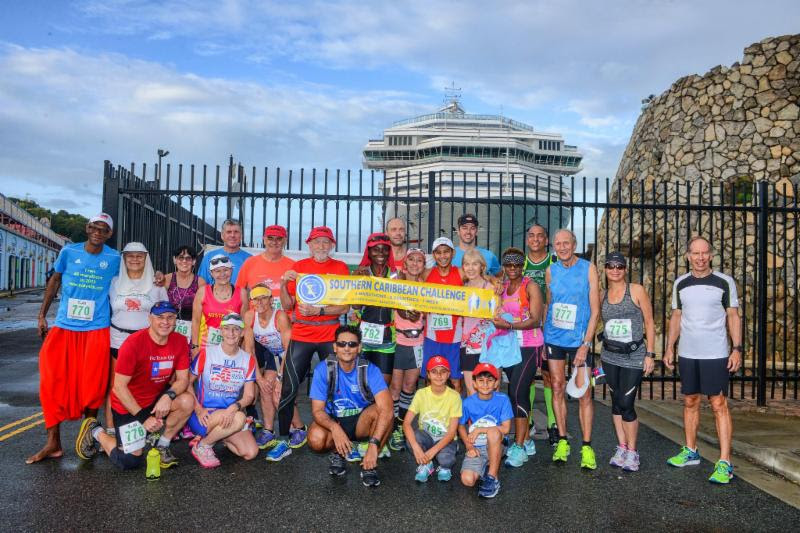
The idea of an active cruising vacation is taken to the extreme in the Southern Caribbean Challenge.

It’s comprised of seven marathons in six countries over the span of just one week. After taking a hiatus last year because of hurricane damage in the region, the runners were on their marks once more this summer. You have the option of running in all or one of the events joining World Record holders from more than 20 counties.

You start your marathon voyage in Puerto Rico and after stopping in St. Thomas, Barbados, St. Lucia, St. Kitts, and Saint Maarten, and — if you’re not entirely exhausted — there’s another race aboard the cruise ship. You don’t have to run a marathon at each of the locations. You can sign up for distances of 5K, 10K, 1/2 and full marathon.

If you’re interested in the 2020 series you’ll have to keep a close eye on when registration opens since the there are only 30 spots available and (for some reason Amanda nor I understand) they fill up quickly. Participants get a chance to explore the islands, meet like-minded adventure-athletes, and soak in the sights and sounds of each destination. Not only that, the comfort of being on a luxury cruise ship will allow participants to relax and enjoy the evenings with family and friends.

We have no doubt that part of that luxury is the spa services to soothe your worn muscles after each run. 

Southern Caribbean Challenge June 2019 in St. Thomas (Courtesy: Bevan Springer)

The package for 2019 included a one-night accommodation in San Juan (twin sharing), transfer from the hotel to the cruise ship, swag (including a T-shirt & hat), race entry fee for all seven professionally managed events by local organizers, medals for each event, welcome reception, credits on the cruise ship and other activities.
If your idea of a Caribbean vacation includes more running than relaxation, this challenge will send you home with considerable bragging rights.


Leave a comment

Chris-Craft Made Sailboats?

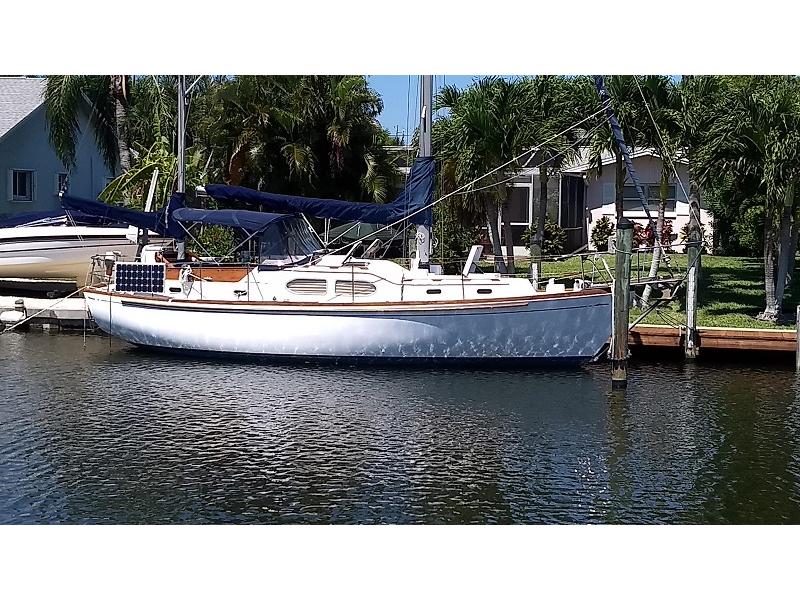
Courtesy: Ray Daugherty

We have been in the market for a sailboat for a while now that we’ve moved to Tampa. The search came to an unexpected turn when we came across a 35′ Chris-Craft Carribean. I was shocked at first. I’ve been a fan of the Chris-Craft brand my entire life. The powerboats they’ve built have been turning heads for more a century. The wood finish of their classic runabout makes her a real looker. You often see them used in any film that has anything to do with Venice. You see a few of them in an epic boat chase through the Venetian lagoon in Indiana Jones and the Last Crusade.

I learned during a search that Chris-Craft designers Sparkman and Stephens were tasked to design sailboats for the legendary powerboat company. It’s like if you asked Ferarri to a motorhome and the results were amazing. In the next 15 years, they built eight models between 26 and 35 feet.

I got the opportunity to do a walkthrough of one of these amazing ladies in Cape Coral, about 2 hours and 20 minutes south of Tampa. The owner Ray has kept her in remarkably good condition. You’d never guess the vessel was more than 45 years old. Her lines are classic with a sharp bluff. The cabin is remarkably spacious with plenty of headroom. You have two staterooms (one fore and one aft) each with a head (bathroom).  The center of the cabin (or the lounge) has a nice dinette and a great galley. He even equipped it with fridge designed by a physicist that specializes in thermodynamics. In short, you can keep ice cream in your galley. I snapped a few pictures during my tour and hope you can appreciate the beauty of this wonderful example of marine architecture.

1 Comment

The Beginning of a Long Journey

The Errant is ready to set sail. You may remember that two years ago my brother-in-law, with some financial help from us, purchased a forty-year-old, 40′ Morgan Sailing Ketch. The boat wasn’t a complete disaster, had a running diesel engine and came cheap. I was excited thinking that we’d be on the water quickly after a short refit. I couldn’t have been more wrong.

The first thing my brother-in-law Matt did was begin gutting the boat like a house you’d see on one of those flipping shows. He took everything out. The interior, with the exception of the engine, was empty. He then set about the tedious process of fixing the soft spots on the deck. The repair usually involved finding a weak point, cutting out the fiberglass and wood and then patching it with new fiberglass and wood followed up by lots of sanding before repainting.

After two years of work, the boat looks amazing. We wrote about the transformation earlier this year in “A New Name for an Old Boat“. Just yesterday, the boat and its crew achieved another milestone: Errant’s journey south from Annapolis to Florida and then to Saint Thomas is underway.

Matt, Andi, and two crew members Sam and Dyan raised the sails and found a heading south through the Chesapeake Bay. Their goal is to meet me in Fort Lauderdale, Florida in about two weeks. I have my fingers crossed they can stick to that timing. I’ll then hop aboard and guide Errant the rest of the way through the Bahamas, past the Dominican Republic, around Puerto Rico and into her new port of Charlotte Amalie, St. Thomas.

We all have experience sailing but this will be our first big trip without a seasoned professionals’ experience to fall back on. Think of it like a pilot taking his or her first solo flight. We know a lot of things can go wrong and if they do success will come down to how we handle them. I have a lot of confidence in our ability, especially my own. I’ll ask you to wish us luck as we make a rather big journey for a novice crew.