Leave a comment

No Kids, Will Travel, Under the Sea

With the warm weather and the pool opening soon, I’ve been thinking back to the diving experience Amanda had at the travel show. I thought our post lacked some specifics, so we got in contact with David Bone at the Atlantic Edge Dive Center in Gaithersburg, Maryland. I, like many of you, love the idea of diving have no idea as to the cost of what looks like an expensive hobby.

I looked into flying lessons a while back and was astonished by the price of learning and licensing, so when David explained the basic cost at his shop at least was fewer than $500 it really piqued my interest.

The road to certification comes in three parts, a classroom session, a pool session and four open-water training dives. Atlantic Edge Dive Center combines the classroom and pool into a one-day class. He said all you need is a bathing suit and the $295 fee includes all of your books and gear for the day.

When you are finished your class work and pool dive you get a referral to take four open water dives. Atlantic Edge refers divers to locations here in Maryland or in a more exotic climate, but the price of the dives in the alternate locations can’t be guaranteed to be the $175 Atlantic Edge charges for staying local. The price includes everything except the “personal gear”, the gear you’ll keep with you as you start your new hobby: masks, fins, snorkel and booties.

You can decide how much gear you want to buy, but things can add up. A good mask can range between $60 and $100. Add $30 for the snorkel and another $100 to $300 for the booties and fins. David assured me you don’t have to by everything; most destinations where you’ll want to dive (e.g. the Caribbean) will have all of that gear built in to the cost or provide it for a small fee.

The overall cost of dives will vary by location. One key factor affecting the price is fuel, which will vary based on the distance you need to travel over water to the reef or dive location. If you’re going on a vacation to dive plan your lodging, transportation and dive boat as far ahead of time as you can.

As I’ve been writing this post I’m more and more convinced that getting certified is something we should do soon. Hey, does anyone know if there’s good diving in Tanzania?

3 Comments

Greece or Not to Greece?

With the American vacation season upon us and people thinking about where they want to go many of my coworkers and friends turn to me with questions – and one question in particular, is it safe to travel to Greece?  My answer is, simply, yes. Greece has been one of the safest places to travel for the last 40 years with the most major crime against tourists delivered in the form of over-priced gyros in old town Athens and a few pick pockets.

The media has made a lot of the country’s financial problems and the riots of the frustrated population. The Greeks, when they do hold mass demonstrations, mainly do so in the center of Athens outside the parliament in Syntagma Square.  I have heard from a family friend in the Athens police department as recently as 5/4/12 who says the city is quiet, calm and ready for visitors.

That said, you can probably manage to skip Syntagma on your Athens sightseeing list and just venture into old town or Plaka for a meal and shopping and head up to the Acropolis without a problem. I tell my coworkers there are 777 islands in Greece and they can find one that suits them or stick with the traditional tourist route.

If you fancy yourself an island hopper you needn’t worry if you’re no longer a backpack hostelling hippy.  With relative ease, you can visit several islands and soak up the culture thanks to the extensive ferry system.  While backpacks are easier to maneuver on the ferry boats, every island I’ve visited had plenty of options for accommodations – ranging from the basic campgrounds to hostels to B & Bs and hotels.

Itineraries
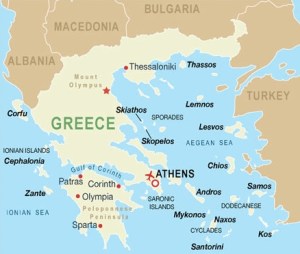
If you’re on your first trip you should fly into Athens and take a connection to Santorini.  The island of Thera (a.k.a. Santorini) is one of those places everyone should see at least once. The white houses look like sugar cubes impossibly clinging to the cliffs around the caldera of a dormant volcano. It’s the perfect setting for what is said to be one of the most romantic sunsets in the world, it is listed in “1,000 Places to See Before You Die” by Patricia Shultz. While on Santorini, you should take some time to have a nice lunch at the Panorama Café.  I have fond memories of this place because it has a great view and it’s the first place Amanda and I truly talked about marriage.

You can work your way back to Athens via ferry from here, and for the most part you can build your itinerary as you go. Find an island you love? Great! Stay there longer than you originally planned, there’s always another ferry on the schedule (with one exception, but we’ll get to that).

Start by taking a boat to Paros and Anti Paros, islands in the middle of Cyclades. You can walk around the maze-like streets of the Chora (main town) and eat at tiny cafés and restaurants.  You can cross the narrow isthmus to Anti Paros for some quiet time on the beach.

Take the next boat to sail to Mykonos.  I will admit, this island is not for me.  It’s packed to the seams with tourists and filled with over-priced restaurants and clubs.  The beaches are nice. A must not miss while on Mykonos is a side trip to Delos. The entire island of Delos is a museum dedicated to the ancient religious center of Greek world.

From Mykonos, catch the ferry to Ios, one of my favorite islands. I recommend staying at the welcoming Homers Inn located halfway between the port and Chora.  The pool at this hotel is beautiful and the perfect place to spend the hot island afternoons.  Ios has a well-earned reputation as a party island with lots of clubs and discos. But if you’re not into the night life you can spend your days on the secluded beaches and quiet narrow streets.

You can then hop a high-speed ferry to Athens, although you’ll have to do some advance planning because the high-speeds don’t run every day and book up fast.  I suggest getting your high-speed tickets as soon as you arrive on Ios. Then you can enjoy the island and avoid worrying about making it back to Athens on schedule.


Plan to spend at least two days in Athens. You can hit the historic hotspots like the Acropolis, Agora and Plaka. If you’re short on time, be sure to see the Acropolis.  You need to stand on the hill and look at the amazing structure and then turn and look at the sprawling city of Athens. I suggest staying in Plaka (Old Town) at the Nefeli Hotel.  The small, no-frills hotel is clean and centrally located. I’ve stayed there on four different trips.

From the Nefili you can hail a taxi for a quick return trip to the airport and the long flight home. Spend the time resting up after your whirlwind tour of Greece. You might be surprised how tiring it can be hopping from one gorgeous, serene beach to the next!
1 Comment

Africa: The Planning Begins

Africa Travel BooksA few months ago, Amanda and I decided on a destination for our next exotic trip, Africa!  I thought this would be a good start to a series of blog posts to detail the planning and preparation that goes into one of those once-in-a-lifetime trips. How do you plan for a trip to a place you know very little about?

The timeline we’ve given ourselves is about a year to plan and save.  I’m not saying we won’t go anywhere between now and then but we’ll keep it close to home, or at least in driving distance for a little while.

The planning began in the place you go when you have any question; Google and the key words “Africa” and “safari”. The search found in 18 million results. Next up, sorting the good from the bad, the useful from the not-so-useful. It’s not an easy task, but we try to focus on travel-related sites we know and trust (like Frommer’s or Fodor’s).

I usually then go to the place I trust for the most reliable information: a good, old-fashioned book.  We headed to the bookstore (yes, they still exist) and found a copy of Fodor’s Complete African Safari Planner. It’s a thick book filled with color pictures and a good breakdown of the whats and wheres of safaris.

We compared our list of needs and wants to what each country had to offer.  We wanted to see lions, elephants, rhinoceros, zebras, basically the best the Serengeti has to offer. The place that seems to have the most of what we were looking for is Tanzania.

Our next challenge is setting a budget. We knew planning a safari wasn’t going to be cheap, but had no idea how wide-ranging the prices and packages would be.

There are purported “bargains” out there for about $1,500 per person excluding airfare (although we’re wary of the get-what-you-pay-for factor at that price point). There are also luxury packages full of spa services, personal chefs and five-star accommodations (yes, on safari) for a mere $14,000 per person.

Here’s to finding a happy medium… or low-end-of-medium in our case!

Leave a comment

Choose Your Own Adventure

The snow has melted in most of the mid-Atlantic and with spring here many are making their travel plans. I have noticed a big problem for those of us wanting to see the far-flung regions of the world; the trip to work is costing us more and more.

I personally spend a minimum of $125 a week on gas, so with my best Bill Clinton impersonation I say, “I feel your pain”.  Those of us who have truly been bitten by the travel bug – so badly it has caused travel fever – won’t let the price of going to work cause us to take the dreaded “Stay-cation”, but the money has to come from somewhere.

The first money saving suggestion I have is to avoid simply picking the first travel package you see. I find packages and tours tempting because they’re easy to book, but they aren’t the best way to save. The first thing you might notice is the “Gateway” fee.  The price your airline ticket will cost if you don’t leave from a particular hub, like New York, L.A., or Chicago. You’ll often have to pony up money to leave from an airport near you, then fly to the hub and leave from there for your destination. I’ve found avoiding this extra step is one of the best ways to save. Start your search with trusted travel websites like Orbitz.com or Kayak.com and find a direct or semi-direct flight from an airport near your home to your destination.

The second way building your own itinerary is better is that most tours double back at the end. For example on a tour of Italy you land in Venice and then go to Rome, Naples, Florence and back to Venice, completely wasting a day of travel gong back to your arrival point to depart. When you build your own itinerary you can fly into Venice and out of Rome, Florence, or Naples. Hell, you could take the ferry to Sicily and fly out of Palermo adding one more amazing stop to your trip.

The third reason I recommend building your own itinerary is you won’t find any of the boutique hotels or boarding houses (or their cheaper prices) on a pre-fabricated list of accommodations. Tour groups generally stay in western-style hotels with continental breakfasts. Not bad, but if you stay there you’ll never have the joy of learning how to shower with a European showerhead. Those of you who have, you know what I’m talking about.

On a tour, you will often find yourself traveling in a bubble, surrounded by other tourists eating at restaurants catering to the selective pallet of most of them. You will be cut off from the more authentic travel experience.

Another great reason to build your own itinerary is time. You get more of it. If you’re visiting a museum or a ruin and decide you have had enough, you can bail. You can walk out the entrance and not worry about where you’ll have to meet up with the bus or the group or the very chipper tour guide carrying an umbrella in the middle of the summer.

Instead, you can find a café, order a drink in your best attempt at not butchering the local language and watch the herds of tourists being shepherded from point A to B on a well-timed schedule.

It might seem like I think the concept of a package is the devil. I don’t.  I know there are many people who love the structure and never having to lift a bag or fight with the showerhead, and that’s okay – for them. There are places a tour is a good thing, Egypt for one, because the group provides security that traveling alone can’t.

You also may find that booking your flight and hotel together can save cash – at least in some of the bigger cities and popular destinations. Travel expert Pauline Frommer says it’s all about competition between the big hotels, so if you’re going that route, be sure to take advantage of that edge.

1 Comment

Greece 2010: Life on Andros

Most Americans celebrated Easter last Sunday, but since I married into a Greek Orthodox family (which I highly recommend) we’re celebrating today — on Orthodox Easter (Χριστός ἀνέστη!). In keeping with the Greek theme, here’s a blog I first composed during our second trip to Greece in 2010:

Ahh, Greece.

"Exemplary Beach at Batsi"

My husband and I are spending a week on Andros Island, about an hour’s highspeed ferry ride from Athens. It’s the island where his great-grandmother grew up before coming to the United States in 1912.

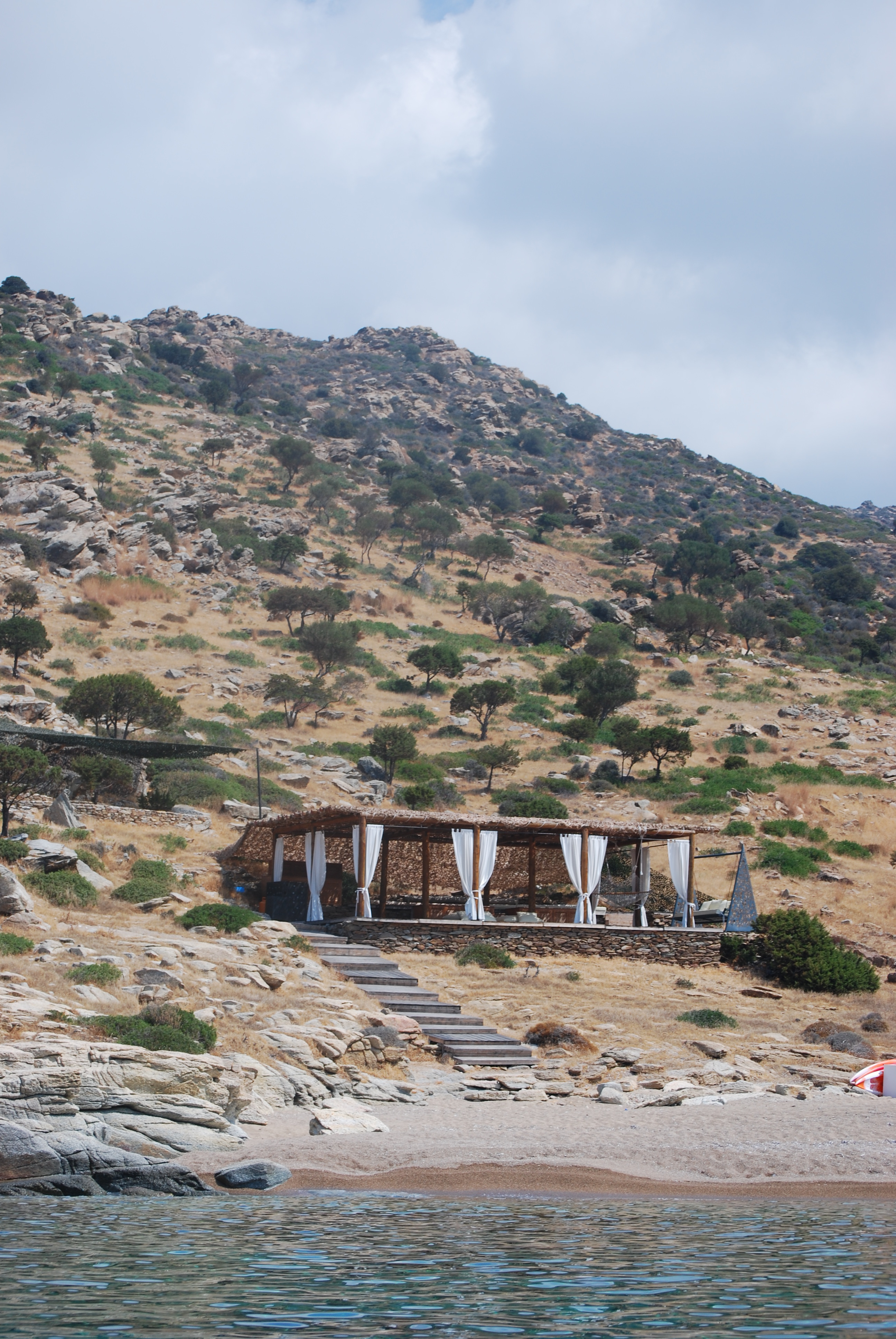
The island is close to Athens, but off the main ferry routes. It’s far less touristy than nearby Mykonos. We love the authentic look at Greek island life, particularly from our apartment just steps from the “Exemplary Beach at Batsi” (I didn’t make that up, it’s what the sign on the beach across the street says).

We arrived completely exhausted after the 24-hour trip from Frederick, Maryland and used the last of our energy getting settled in and grabbing dinner at the first taverna in the row along the water’s edge.

We’re still working on getting our clocks turned around, we’ve been sleeping in until at least 10am for the past two days. That’s very late for us, but then again – we don’t have a schedule to keep!

So far our routine includes coffee and fruit on the balcony, several hours of sun and time in the cool, calm, clear water, showers, a light lunch, nap time, walks to explore Batsi, dinner and bedtime. It’s delightfully devoid of anything that “needs to be done”.

It’s been a lovely, restful vacation, just what we needed.

1 Comment

Expanding Your Comfort Zone

“If you stand in the center, you will never be amazed. You will safely see what you have already seen, know what you already know. You will never start a fire in the mind of another or be party to the exuberant chaos of invention. But if you are bold – if you step to the edge – you can unlock the embrace of the familiar and open your mind to the daring notions of others. When you venture to the perimeter of your understanding, your eyes widen, your senses sharpen, your intellect becomes more agile.”  – Unknown

I’m not usually one for inspirational quotes, but this one gets me. One of the reasons we love travel (so much that we blog about it right here for your general amusement) is our desire to experience the unknown.

My first trip overseas was a 10-day adventure through Italy with my well-traveled friend (and eventual husband), Zeke. Leaving the United States beyond a carefully-orchestrated cruise through the Caribbean or a visit to Atlantis was well outside my comfort zone. That was part of my rationale behind asking Zeke to go with me; he had already been to Greece, England and Egypt. He knew the routine, how to navigate a foreign airport, where and how to get money exchanged, even how to muddle through when you don’t know the language. Zeke helped me expand my comfort zone, and (obviously) I was bitten by the travel bug.

We’ve already discussed some of Travel Channel host Samantha Brown’s finer moments with foreign languages. In spite of a few moments she’d rather forget, she maintains it’s better to butcher the language and show you’re trying than to expect everyone, everywhere adapt to your language. No one on the other side of the conversation will expect you to be fluent, but knowing how to say hello, please and thank you is essential.

Over the years, my comfort zone has expanded to include not only Italy, but Greece, England, Canada, Mexico (at least the areas suited for tourism)  and several lovely Caribbean islands. My list is nothing compared to Samantha Brown‘s, of course, but she shares our inquisitive nature — and there is still somewhere on the planet outside of her comfort zone. She’s so excited to see it, she’s trying to get the Travel Channel on board to film her next show there:

3 Comments

Tourist vs. Traveler


What separates a tourist from a traveler?

I like to think it has a lot to do with who you meet on your journey.  A few years ago Amanda and I traveled to Mexico.  We decided to try the resort thing and hated it. We felt cut off from the country we had flown to visit.  I mean, who needs a private beach packed with big Russian men in little Speedos?

The time we felt most connected to Mexico was the evening we spent in walking the streets of Playa del Carmen.  The meal we had in the town was the best of the trip by far and the beach looked beautiful at sunset.

I’ll admit Playa del Carmen caters to tourists, and it’s probably still difficult to make a true connection to the culture there.  Fortunately I have another example with similar conditions.

The sunny island of Saint Thomas in the U.S. Virgin Islands is another perfect example of a place you might think beyond the capacity for an authentic connection.

You might say “Saint Thomas? Don’t like a thousand hula shirt and sunscreen-wearing suburbanites invade the island daily?”  To which I respond, “Yes! It’s all in where you stay.”

When we’re in Saint Thomas we like to stay in Frenchtown, a small community on the outskirts of Charlotte Amalie.  The neighborhood is filled with restaurants packed with locals, some of whom – if you listen carefully enough – still speak a French dialect.  We stay at the Villa Olga hotel, a locally-run business with managers who live on-site.  Staying away from the throngs of tourists gives us the opportunity to mingle with locals at the bar or the deli counter and get to know the people and the island better than through the pages of any guide book.

The places you stay and the connections you make with people are what make you a traveler and not a tourist. You can even look at more exotic options than a locally-run hotel; you could stay in a room to rent in a private home or in a convent or a monastery, all recommended by travel author and world-renowned expert Pauline Frommer.

1 Comment

How Professional Travelers Do “Vacation”

Nope, we’re not talking about ourselves here. We’re far from professional travelers (for now).

Long-time Travel Channel host Samantha Brown (@SamanthaBrown) was in Washington, DC for the Travel and Adventure Show in mid-March. Her seminar, A Comedy of Travel Errors: My Globalization of Mishaps, was a journey through some of the more uncomfortable moments of her traveling career.

In one example, Samantha recounted going to Paris for the first time. She practiced with French language tapes leading up to the trip, but once she entered her first Parisian cheese shop and the woman behind the counter spoke to her (in rapid-fire French, not simple staccato nouns), she froze. Not only did all of those French tapes suddenly flee from her memory, she also lost her grasp on English. The woman offered “Anglais? English?” but Samantha’s brain had gone to mush. She ran out of the shop with tears running down her face.

It would have been easy to go back to her hotel room, cry it out, and decide she didn’t like Paris. Instead, Samantha hit the grocery store for a quick crash course in French language. It’s a tactic she still uses today, calling canned goods “colorful, cylindrical flash cards”. Plus, she notes, perusing the aisles in a grocery store doesn’t single you out as an obvious tourist. If anyone notices you, it’s more likely you’ll look like a cost-conscious shopper.

“Travel is imperfect, we are imperfect,” Samantha said, “and when the two come together you can have a wonderful time.”

Considering Samantha’s extensive travel-based career (and associated wisdom), we wondered whether or not she ever gets to travel with her husband and if they ever get to take a vacation (you know, for fun). As you might imagine, having a job that sends you on the road 200 days a year changes your perspective.

4 Comments

Intro to Scuba

As a 30-something-year-old woman, I’m not overly fond of swimwear. It’s not terribly forgiving, let’s just leave it at that.

While I may not love the wardrobe required, I do love the water. From the local swimming pool to Zeke’s parents’ hot tub to the warm, clear waters of the Caribbean, it’s my favorite element.

So it should come as no surprise that when we arrived at the Travel and Adventure Show in Washington, DC (March 17, 2012), we headed right for the pool. Beadiver.com had the four-foot-deep dive pool warmed to about 80 degrees, pretty much perfect in my book. I changed into my swimsuit in the changing tent, and then the helpful experts with beadiver.com got me ready for my first scuba experience. With fins, mask and dive tank in tow, I backed down the ladder into the warm water.

I’ll admit, I was a little nervous. I thought I might be claustrophobic or uncomfortable with the whole idea of breathing while under water. The guys with beadiver.com were excellent guides without making me feel like an idiot. They explained the basics of the equipment and the right way to use it, taught me a couple of hand signals, and told me to kneel or stand up if I had any trouble. Having that option was comforting and eased some of my nerves.

I took a deep breath through the regulator and eased down into the water. I was a little surprised how easy it was, how effortless. I don’t know why I would have expected it to be daunting or challenging, but now I know better.

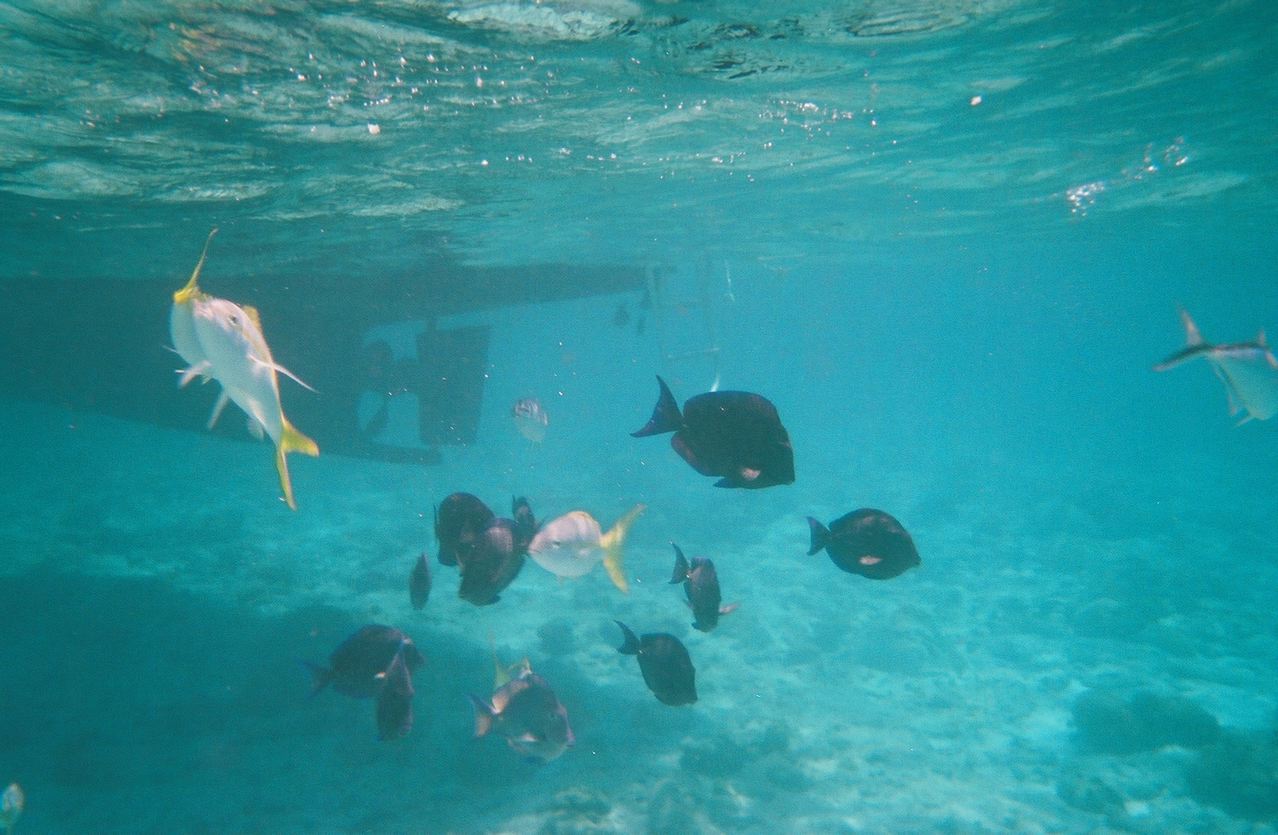
I’ve been snorkeling before and thoroughly enjoyed it, but after experiencing how easy scuba diving can be (even under very controlled and simplified circumstances), I’m looking forward to looking into certification and a dive in my near future (look out, Frederick’s Brass Anchor Scuba Center)! If you are in Northern Virginia we sugget checking out Sterling Silver Scuba.

1 Comment

Must-Taste Toronto

I shop at a supermarket, but have rarely been to a truly Super Market.  In the heart of downtown Toronto is the Saint Lawrence Market.  The market, founded in 1803, is the easily the size of any big box store and is filled with hundreds of vendors.  The first thing you notice when you walk into the large brick building is lots of people pulling their grocery carts behind them, each overflowing with fresh produce and fresh bread. Saint Lawrence is a locals’ market.  The population of downtown Toronto hasn’t abandoned their individual market vendors for the allure of national grocery store chains (yet) and after a quick walk around you’ll see why.   The soaring ceiling gives even the most claustrophobic among us a since of space while walking along the crowded market floor.



The second thing you notice is the color; an explosion of reds, greens and yellows surround you as you walk into the produce section.  I was even tempted to fill a bag with fresh produce, and as my wife will tell you, for me eating a salad is an accomplishment.

The produce isn’t the only attraction, the fresh bread, meat and cheese are there to fill up you cart, too. We even found a vendor selling every baking accessory you could ever need if you chose to make your own bread and cookies.

If you’re a tourist, you don’t really have the option of cooking your own meals; most hotels frown on you setting fire to their rooms.  I suggest eating at the market or grabbing an apple or some strawberries to go.

Have you ever had a fresh bagel?  You won’t find a fresher one than at the shop at the market.  I stood transfixed watching the bagel maker slide a six-foot pallet of bagels into the oven then scoop them up with ease and dump them into the bin.  Amanda will tell you the bagel she got was the best she’s ever had.

I chose to go to the set of shops downstairs for my breakfast.  I got a made-to-order sandwich (as in we watched them fry the eggs after placing the order) and downed it quickly. The multitude of eat-in options is one of the main reasons I recommend a visit to Saint Lawrence Market.

Even if you’re in Toronto for just a day you should stop and take a taste of Saint Lawrence Market.

The Market Hours

Tuesday, Wednesday, Thursday: 8 am to 6 pm
Friday: 8 am to 7 pm
Saturday: 5 am to 5 pm. (South Market and Farmer’s Market)
Closed Sundays and Mondays.